
One hundred years ago this morning, residents and newcomers to America’s Playground in Miami Beach awoke to what early Miami transplant, journalist, and famed conservationist Marjory Stoneman Douglas described as “a sea of raving white water.”
Nearly 11 feet of whitewater was hoisted from the Atlantic Ocean and heaved in waves across the entirety of newly filled Miami Beach.
A brand new 3-cup Robinson anemometer installed atop the three-story Allison Hospital in present-day Mid-Beach gusted to 128 mph by 7:30 AM on Saturday, September 18th, 1926, before blowing away less than an hour later.
As the hurricane’s large, 43-mile-wide eye engulfed the Magic City shortly before daybreak – stretching from present-day west 63rd street on Mid-Beach to just south of Homestead – a sudden calm fell over the city, sending shell-shocked survivors into streets, believing the storm to have passed.
Seeing the mainland across the recently-completed County Causeway (present-day MacArthur Causeway), those stranded on Miami Beach piled into their cars to escape the wreckage surrounding them, but cars on the Causeway never made it to the other side before the “second storm” struck minutes later.

Of the nearly 400 official deaths reported by the American Red Cross from the storm – a count which excluded scores of Black farmworkers lost in the hurricane – most died during its hellish second half. At the time, most had no concept of the rotational forces of a hurricane and marveled at how the storm had managed to stop then “change direction.”
The Great Miami Hurricane of 1926 was an inflection point for the vibrant city awash in unrestrained real estate development. The great Florida land boom of the early 20th century was washed away with the storm surge and whisked away with the wind. The same land in 1925 that sold for $60,000 was available for $600 a year later. Legendary South Florida developers like George Merrick, Carl Fisher, and D.P. Davis – who made fortunes off the land speculation frenzy and whose names still adorn familiar spots across Miami – were left in financial and personal ruin in the wake of the hurricane.
Though the Florida real estate collapse triggered by the 1926 Miami Hurricane may not have directly caused the Great Depression, it pricked the national real estate bubble of the Roaring Twenties, serving as a catalyst for the protracted economic contraction that followed.
Costliest hurricane of all time
At the time, the Great Miami Hurricane of 1926 caused around $100 million in damage, making it the costliest U.S. hurricane to date and the costliest disaster to hit the country since the Great 1906 San Francisco Earthquake and fires.
Given the increase in population, property, and living costs in South Florida over the past 100 years, if the same hurricane were to hit today, researchers estimate total economic losses would exceed $200 billion, making the Great 1926 Miami Hurricane the costliest storm on record.

It’s worth noting that while the Category 4 1926 Miami Hurricane had lower peak winds than Category 5 Hurricane Andrew in 1992 (145 mph maximum sustained winds versus Andrew’s 165 mph peak winds), Andrew was a much smaller hurricane – about half the size of the Great 1926 Miami Hurricane as measured by the extent of its strongest winds.

Andrew also struck about 10 miles farther south than the 1926 hurricane, sparing downtown Miami and Miami Beach its most catastrophic weather.
Friend, colleague, and former WPLG-TV hurricane specialist and National Hurricane Center Director Max Mayfield famously said “Hurricane Andrew was not the big one.” We’ll know the big one when it hits, but the Great 1926 Miami Hurricane is probably as close as it gets for South Florida.
Florida’s start to better building
Florida has some of the most stringent building codes in the world today, but it didn’t start out that way. In 1926, building codes, zoning, and inspection requirements were virtually nonexistent across Miami Beach and Greater Miami. In the wake of the Chicago fires of 1871 and the widespread fires caused by the 1906 San Francisco earthquake, meager building requirements at the time were limited to fire and sanitation concerns, not to guard against strong winds.
The frenzied construction during Florida’s land boom wasn’t about to slow for building oversight. The one exception was around George Merrick’s new planned community of Coral Gables, which did implement relatively strict building codes for the period. While Coral Gables suffered considerable damage during the hurricane, not a single life was lost.
After the hurricane, the city of Miami appointed John Farrey its first chief building inspector, tasking him with developing and enforcing the first universal building code not just in Miami but in the U.S. It became known as the Miami Standard and was adopted in over 5,000 other cities thereafter. The state’s building code has been updated and improved numerous times since, including most famously after Hurricane Andrew in 1992, with the passage of the landmark 2002 Florida Building Code and another major update in 2017.
Additionally beach erosion control starting in the 1960s followed by dune restoration in the 1970s hardened the shoreline against approaching storms. Today Miami Beach has 7 miles of shoreline dunes, continually replenished and designed to reduce damage from the next hurricane.
Instead of crumbling, Miami marches ahead
Miami wasn’t the first coastal boomtown in the U.S. to be hit by a big hurricane. In the late 1800s, the rapidly expanding and thriving port of Indianola, Texas, was decimated by powerful hurricanes in 1875 and 1886, submerging most of the town deep under Matagorda Bay.
Likewise, neighboring Galveston, which took over as the major port of Texas after Indianola was a booming metropolis by the turn of the 20th century and was on pace to become one of the most important cities in the U.S. and largest in Texas. The Great 1900 Galveston Hurricane ended its Golden Era and the port city would never recover to its previous levels of national prominence or prosperity.
The same can’t be said about Miami, which has a history of recovering from big hurricanes, largely by learning and adapting to better co-exist with hurricanes.
Tropical Update: 98L folds as 99L takes shape southwest of the Azores
Nearly all computer models – including the formerly bullish AI camp – have dropped development chances for Invest 98L, the low-pressure area spinning over the open central Atlantic, over the past 24 hours. Overnight NHC in turn dropped the system from its tropical weather outlook.
Meanwhile, a small but tenacious area of low-pressure southwest of the Azores in the far northeast Atlantic – now designated Invest 99L – has quickly organized, leading NHC to issue a special tropical outlook late Friday morning.
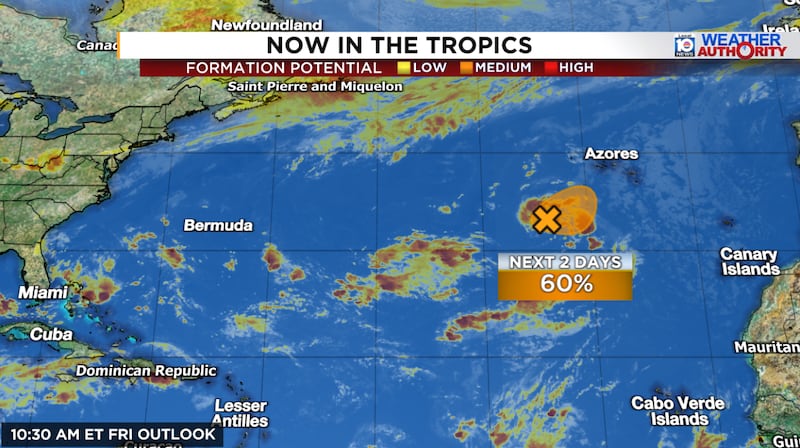
Though the system isn’t expected to strengthen much, it could become a tropical depression or named storm by as early as today. The next name on the list is Fay.

99L or what forms from it will head southwest and remain over the open Atlantic. Otherwise, no development is expected elsewhere across the basin into at least early next week.
Copyright 2026 by WPLG Local10.com - All rights reserved.
